
My therapist: Brazilian Bakunin doesn’t exist
Brazilian Bakunin:
I have some software running (behind cloudflare and results tailored to Brazil on SearXNG because of the brazilian IP):
Feel free to use on Libredirect or directly!
My therapist: Brazilian Bakunin doesn’t exist
Brazilian Bakunin:


Hagezi normal is the best one, in my opinion. No false positive ever and more lightweight than the others, also has a good coverage. Adguard domains is nice too.
On filterlists there are a lot of them, ublock, domains, IPs, hosts (ipv4 and ipv6), etc.
On the .desktop file, I don’t think it can load .desktop files, but it can load an .exe with a specified version of wine or proton, going to the + at the top left, then add manually an already installed game, then selecting the runner to be wine, select the path to the .exe, then select the wine version at the runner options, then you can create a desktop file with lutris.
If you changed /etc/hosts, it might be that, about the receiving info from the server on this:
002c:err:winediag:getaddrinfo Failed to resolve your host name IP
0024:fixme:ntdll:NtQuerySystemInformation info_class SYSTEM_PERFORMANCE_INFORMATION
But the proton version might help as well (I didn’t understand the problem specifically)
Did you try running it with proton on a clean wine prefix? It already comes with a lot of dependencies.
Maybe proton-cachyos-slr or Proton-GE.
Edit: Proton-GE has better compatibility
Edit 2: About the address info, did you change your /etc/hosts file?

I read that people use it for servers boot images too. Seems very versatile.

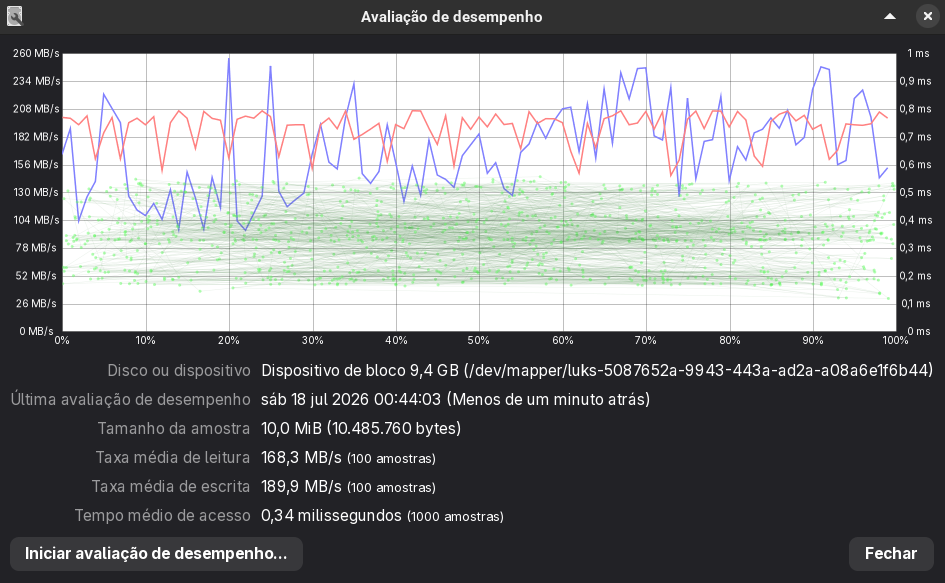
Yeah, the reads are A LOT faster than my ssd and the latency is nil.
A line of memory from Intel that’s like NAND, but it’s not NAND. It’s 3D Xpoint, very good at random reads or sequential reads.
sudo hdparm -t /dev/nvme0n1p1

/dev/nvme0n1p1:
 Timing buffered disk reads: 2682 MB in  3.00 seconds = 893.33 MB/sec
sudo hdparm -t /dev/sda

/dev/sda:
 Timing buffered disk reads: 670 MB in  3.01 seconds = 222.89 MB/sec
Edit: when the swap was at my main drive, the sequential reads were like 140 MB/s
I only tested with those applications, but I could benchmark using my ssd vs the drive tomorrow or later. Download a RAM heavy game or something.
Do you have a recommendation?

deleted by creator

About quality (I don’t live in Estonia, but I’m trying to help), BeaconDB seemed better or equal to positon.
About privacy, I believe that positon is related to e/OS and microg and BeaconDB is independent, with its code being open source, but the beacon data is closed and not released, so you can’t self-host the server without the data, but you can probably get the data from ip based sources (like dbip) and opencellid.
That’s all I know about this.
Edit: The discussion on releasing the BeaconDB data, it’s very interesting

It depends, if it’s a problem I’m trying to solve, if it’s a presentation that I’m going to do, if I need to communicate with someone. Like I thought about responding this, while trying to observe how it works.
Normally there are a lot of monologues happening at the same time and I’m probably listening to music too, so I’m like 30 seconds thinking about something, pass to another something and then the good part of the music comes. I took ADHD meds once and damn, this completely disappeared hahahaha.
But, depending on the thing, if it’s a concept I’m trying to tackle, normally it’s just me alone passing through it, its ramifications, consequences, basis, etc. If I’m trying to talk to someone, I like to imagine them and interact with myself playing as them. Sometimes it’s like yours, two of me separated from me “debating”.
Read “Black skin white masks” from Fanon. He talks about this phenomenon and race in general.
Edit: Explaining a little bit about what’s on the book on this.
Basically, on the racist framework of society, black will always be bad, being black as the worst and lowest of the social hierarchy. Being mixed, means almost white, almost there, so a white man is the necessary status to be or feel white, also kids would be whiter. Going with a black man means going back, retrograding into a state of blackness, etc.
I’m not saying this about these women specifically, but at the structural level, what is expected in relation to race.
Edit 2: wording

What website was it?
But I agree that some websites might need adjustments.
Forgot the https:// on the link, fixed
Thanks for the heads up!

The way out of liberalism’s crisis is not to abandon liberalism. It is to recover its radical spirit. Liberals should once again be the people who hate monopoly, inherited advantage, closed systems and rigged games. They should champion real competition, real meritocracy and real equality of opportunity. They should take on corporate power when it crushes markets, government power when it protects insiders and cultural power when it creates bureaucracies that substitute group identity for individual dignity.
As Wooldridge argues, the center cannot be merely a midpoint between left and right. It has to be revolutionary in its own way. Liberalism’s great promise was never that people would be left alone to decay in freedom. It was that people would be given the tools, rules and responsibilities necessary to flourish.
Liberalism began as a revolt against encrusted power. It will survive only if it becomes one again.
Edit: Basically, the fight against everyone else is to promote meritocracy, markets and competition. Basically the same talk 19th century liberalism did.
Two recent events, on opposite sides of the Atlantic, point to the same problem. In Britain, the man widely expected to replace the stately Keir Starmer as prime minister is Andy Burnham, who touts “business-friendly socialism” as his credo. In New York, Democratic primary elections produced striking victories for democratic socialists, suggesting that the insurgent left has found a way to turn protest into power.
First, a caveat: The left is not marching uniformly toward socialism. Many primaries outside New York City were won by moderate Democrats. In a swing district just outside the city, combat veteran Cait Conley won handily. But a certain kind of liberalism is losing energy, confidence and connection to the people it claims to represent.
In Adrian Wooldridge’s new book “The Revolutionary Center,” a brilliant intellectual history of liberalism from the Enlightenment to the present, Wooldridge reminds us that liberalism was once the most radical force in politics. It attacked inherited privilege, monopoly power, censorship, aristocracy, clerical authority and closed guilds. It was not the ideology of the establishment. It was the battering ram against the establishment.
Today, liberalism has become identified with power — great universities, foundations, media organizations, corporations and bureaucracies. Wooldridge argues that this has produced two deep failures.
The first is passivity. Modern liberalism, certainly since the 1990s, has celebrated free markets and free people. In practice, that has meant deregulating both economic life and personal life, then treating the consequences as the price of freedom. In markets, this has allowed corporate consolidation and inequality to run wild. In personal life, liberals have become reluctant to say that certain behaviors are socially destructive.
The result is liberal fatalism. People camp out on city streets, addicted and mentally ill, and liberals often describe this as a housing problem. Millions suffer from obesity-related illnesses, and liberals are more comfortable blaming “food deserts” than taking on the companies that hook their customers on processed food. Social media companies do the same with their consumers’ attention.
Wooldridge calls for a revival of liberal paternalism. The phrase grates on modern ears. But a liberal society should celebrate individual rights — and also demand individual responsibility. It should understand that freedom can be destroyed not only by the state but also by addiction, monopoly, crime, ignorance and dependence.
This is not an argument for socialism. It is an argument for truer liberalism. Liberals should love markets not because they allow the strong to dominate or inequality to grow, but because genuine competition allows the little guy to challenge the strong. A healthy market is not one in which four companies quietly divide up an industry and use lawyers, lobbyists and algorithms to keep challengers out. It is one in which new entrants can rise, consumers can choose, workers can move and incumbents can fail.
The second failure Wooldridge identifies is more uncomfortable because it concerns liberals’ own status. Liberalism believes in meritocracy. Historically, this was one of its noblest causes. It argued that people should rise by talent and effort, not birth, race, caste or class. But over time, the meritocratic elite has hardened into its own aristocracy.
Elite liberals support social justice, but do little to dismantle legacy admissions. They want the poor to move up the ladder, but not if that requires building more housing in the leafy neighborhoods where they live. They praise individual merit, but have created a vast diversity bureaucracy that too often judges people by group identity rather than individual character.
Nowhere is this clearer than in K-12 education. A genuinely liberal politics would start with the child. It would attack any institution — union, bureaucracy, school board, university department — that feeds its own power while failing America’s children.
This is where democratic socialists and right-wing populists gain their power. They understand that people want someone to fight for them. They may offer bad answers — the left with class warfare, protectionism and state control, and the right with protectionism, ethnic resentment and racial nostalgia. But they sound like outsiders willing to take on entrenched privilege and offer protection in a world where freedom seems to mean chaos.





















Human knowledge by Bertrand Russell. Probably going to keep reading it for a month or two hahahah.