

- cross-posted to:
- microblogmemes@lemmy.world
- cross-posted to:
- microblogmemes@lemmy.world
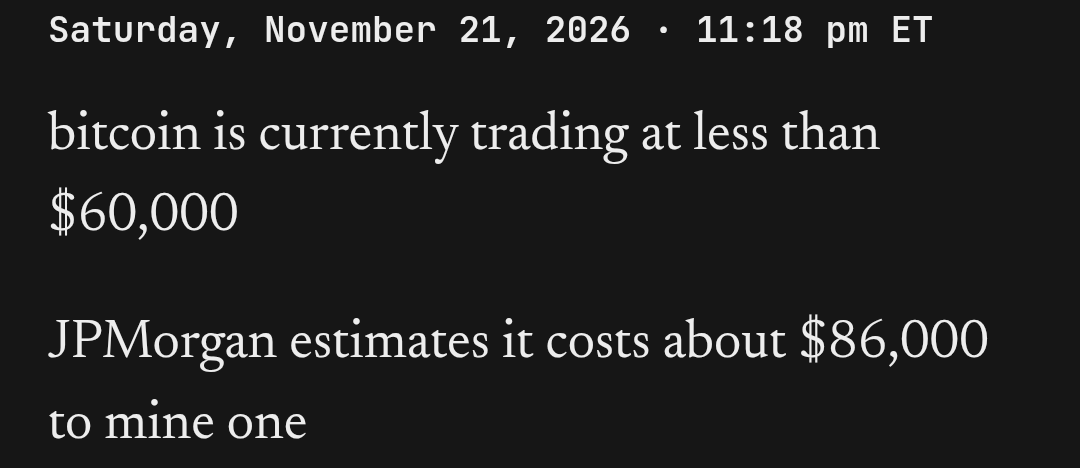
bitcoin is currently trading at less than $60,000
JPMorgan estimates it costs about $86,000 to mine one
Source: Molly White on social media.
That’s still working as designed, though - a miner with chronically high costs relative to other miners should go out of business and stop mining. They’re evidently just not good at it.
There’s no “design” here. Individual participants make their own investment decisions on building out the servers to mine Bitcoin at scale, and then over the useful life of that hardware it mines Bitcoin when profitable and then the hardware is retired or sold for another purpose once it’s no longer profitable. They plan things out with an assumption about energy costs, Bitcoin prices, etc., and sometimes those long term projections turn out to be wrong to where they have to retire the hardware earlier than initially planned, or having a lower utilization rate over the course of its useful life, and they lose money on that.
The macro equilibriums make the system as a whole survive, but individual players can and do get wiped out from shifts in prices that break their assumptions. And sometimes it swings the other way, too, where they make windfall profits they weren’t expecting.
You said there was no design and then immediately described the design in detail. That’s exactly how it’s supposed to work.
You can describe a rule, and maybe even describe the motivation behind the rule’s design, but the behavior around the entire set of rules and incentives doesn’t always become obvious until multiple iterations of participants actually playing in the arena, so to speak. And the way the participants behave is often not predicted by the people who design the rules. You can see this in rules updates in sports, markets, regulations, etc.
The cost structures of the miners can often lead them to keep their mining operations going even when they have to operate at a loss, short term. They’ve got interest payments, might be paying rents and insurance and other fixed monthly costs, have certain obligations to buy/take a certain amount of electricity from their power purchasing agreements, etc. The difficulty can change in response to the amount of effort being expended across the network, but the participants may not have the legal or financial flexibility to perfectly jump in and out of participation in the market in a way that feeds back as you’d expect. So that feedback mechanism won’t actually behave “as designed,” in practice.
Except this is actually how it was meant to work all along. Really, this is the design. Miners are supposed to join or drop from the blockchain based on whatever economic incentives make sense to them, it’s not the blockchain’s responsibility or role to “manage” them in any other way. If a miner has come up with some kind of special deal for electricity or is accounting for depreciation in some idiosyncratic way, that’s fine - that’s on them to handle. The Bitcoin blockchain doesn’t care about that, it’s designed not to need to care about that.
All it cares about is the rate at which blocks are being found, not who’s finding them. That’s the only “feedback” mechanism built into Bitcoin. If blocks start coming in too fast the difficulty rises at the next adjustment period. If they’re coming in too slow the difficulty falls instead. The underlying reasons for those changes are simply not relevant. Could be legal issues, could be electricity market forces, could be new types of mining hardware being invented, doesn’t matter.
And I’m describing how that mechanism doesn’t actually push the cost of mining below the cost of buying an existing Bitcoin. Bitcoin miners are continuing to mine at a loss, which is keeping the difficulty higher than the average miner’s costs.
In other words, mining isn’t guaranteed to be profitable either for any given individual miner or for miners on average, and there is no design that ensures that it does. To whatever extent there was intention behind the design, it either isn’t directed at miner profits at all, or has failed in its design to keep miner profits near zero.
That’s what I’ve been saying this whole time. There is no design for the profits or losses to play out in any particular way.
You said:
Emphasis added.
What I originally said:
Emphasis added. I’m talking about the long term.
Sure, a miner could just keep on burning money to mine at a loss indefinitely if they wanted to. There may even be a few rare circumstances where there’s a non-monetary reason to do that - for example, it gives you “fresh” coins to work with, maybe you want a coin that can’t possibly be traced back to a previous owner for some reason. But that’s a rare thing, it’s not going to motivate the vast majority of miners to continue mining in ways that don’t earn them money.