
Crossposted from https://fedia.io/m/leftymemes@lemmy.dbzer0.com/t/4518262
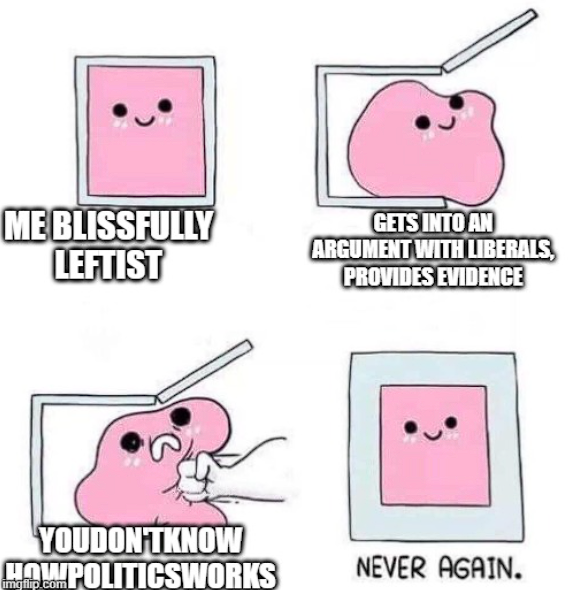
Inspired by this thread where at least five different libs made the same point and responded the same way when I tried to poke their bubble. Seriously CTRL+F my username or the word “voter” it’s downright surreal. The hivemindness of the affair was also pretty weird, but I’m not one to meme the same interaction twice.
If you’re gonna use the original definition of conservative, why not use the original definition of liberal, too?
I did. No kings, everything should be determined by private wealth. That is the original Liberalism. It was a philosophy of and by the merchant class who couldn’t convert their massive profits into power because power was centralized in a king and distributed according to long histories of relationships and tradition. Merchants could make all the money they could find but still couldn’t buy titles to land, and they were upset about it.
That’s why Liberalism is focused on private property and calling it “a right” and coming up with ridiculous framings for where that right comes from. The idea of universal rights was a sort of natural development from arguing against divine right to rule. But of course, liberals only applied “universal” rights to rich white men, so they started walking a tightrope of “we need to undermine the power of the king” on one side and “we can’t give the poor teeming masses power over us” on the other side.
This is where Liberalism because internally contradictory. Private property and universal rights are diametrically opposed at a logical and systems level. There’s lots of ways to prevent the contradiction from coming to a head though, for a time anyway, and the most obvious is territorial expansion. So long as you can steal entire continents from indigenous people, you can privatize land for centuries before the system starts to show major signs of strain.
In essence, Liberalism emerged when the potential for allocating larger amounts of resources became possible and feudalism couldn’t maximize the opportunity. Merchants accumulated these vast sums that couldn’t be properly deployed and Liberalism, with its focus on private property and eliminating any central planning or coordination function from society, emerged to solve that problem. But it needed the masses to support it, so it developed a value system that everyone could support but only benefitted the few.
And now that Liberalism’s economic system, Capitalism, has reached a crisis at the global level, the contradiction inherent in liberalism (private property on one side, universal liberation on the other) is so sharp that Liberalism is falling apart.
And when it does, we have two options: move to the lower energy state of feudalism where warlords and monarchs decide how to allocate resources based on their relationships and waste massive amounts of surplus, or move to the higher energy state of communism, where governments evolve from the current representative democracy that tried to maintain Liberalism/Capitalism into new democratic forms that adopt the responsibility of deliberate planning and cultivation towards a future state that relies less and less on the structures of hierarchy and violence to maintain the contradictions of class society.
I see, liberalism was created for the purpose of upholding an economic system which would not exist until nearly a century later.
Genius!
Oh boy. One of you people.
No, Talcosis. Liberalism was created to solve a systemic economic imbalance caused by how power was distributed in feudalism. The resulting system that Liberalism produced from its first principles (namely, people who go out and make a lot of money should be able to do whatever they want with that money) resulted in what we now call capitalism. That’s why Liberalism ascends in near lock-step with mercantilism. Because it’s a philosophy driven primarily by the aggrieved merchant class.
Oh, okay.
So why use the original definition of conservatism but not the original definition of liberalism?
Say more. I think I am using the original definition of Liberalism. What is the original definition, as you understand it, and how does it differ from what I have provided?
The right to self determination.
Yeah, so like I said, that comes from the economic pressure built up by merchants who were free to go make their fortune but not free to buy power and change society. A lot of liberal theory was developed from observing charter cities, which were places rich merchants and bankers built after they convinced a king to sell them a charter to a piece of land. They created all sort of new ways of operating on this theory of self-determination. Except it was only positive self-determination for the rich and landed. The workers were “self-determined” in that they could choose which abusive rich merchant they could work for.
This is what I mean. Liberalism is internally contradictory because self-determination and private property are diametrically opposed when you scale them up. Claiming natural right to murder anyone who steps foot on a piece of land, and to pay people to do that murdering for you, and to pass that right down through inheritance, or sell that right to the highest bidder, is only self-determination for the minority. For the majority of people, their lives are determined by what the ultraminority rich allow them to have, and of course the smartest move is for the ultraminority rich to collaborate, even without direct and explicit coordination, in making sure the majority are always weak, divided, focused on their own survival, and fighting each other instead of the rich.
That’s liberalism, from the beginning. It’s never been anything except that.
Oh, don’t worry, I understand exactly why you’d like to keep the conversation focused on economics and not consider at all what it means for the mechanisms of state oppression.