
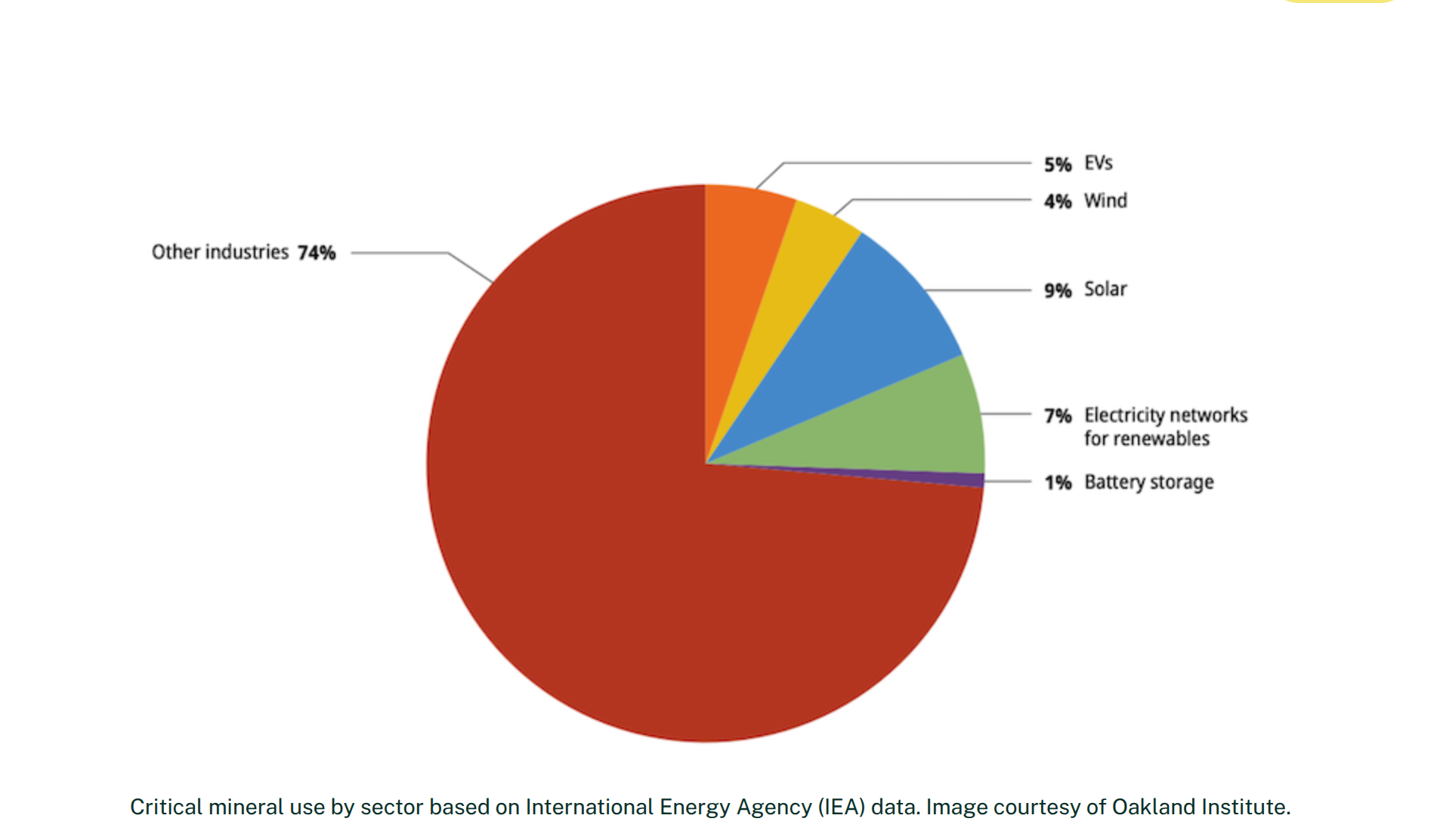
The world needs to move from fossil fuels to renewable ones, but the narrative pushed by powerful financial, political, and environmental institutions — that it’s necessary to massively scale up mining of “transition” or “critical” minerals to achieve this — is false, a new op-ed argues.
Not only do these minerals’ extraction cause countless environmental and community harms, the numbers cited about how they are used — and the number of new mines needed — don’t add up, a recent report has shown.
“The vast majority [of critical minerals] are used in industries that are either unrelated — or in direct opposition — to the clean energy transition,” the author writes.
I have had so many debates about so-called minerals depletion that I ended up giving people quick advice:
If you think a mineral is problematic, do two things:
-
Find the appropriate report of the USGS on that mineral. Here is the link. Note that “rare earth” is a report of its own but some of the minerals called that have a separate report.
-
Go read their definition of reserves and resources. This is not an optional step because that’s where a lot of misunderstanding comes from.
-
I said step 2 is not optional, but in case you skipped it, here is a dumed down version
-
Regarding those minerals, Li, Ni, Co and Mn play an important role in electrification, but they don’t have to. It’s just that in recent decades we’ve built the production chains necessary for producing LIBs (Li-ion batteries), and now we’re kinda stuck with that technology. Recently, NIBs (Na-ion batteries) started to become viable, and I really hope they manage to ramp up production quickly. Seems like the author of that article was thinking of LIBs all the time and forgot about NIBs. The problem is, it takes a long time to build the production capacity and production chains.
Then there’s also copper. It’s kinda hard to ignore that one, since we can’t really electrify things when the grid can’t handle the load. Also, electric motors require lots of copper, so I can imagine that the demand for copper will remain high in the coming decades.
Isn’t the copper largely an easy one to recycle though? Just offer some drug addicts their next hit and they will provide you with recycled copper.
Yes, copper recycling totally works, just like Fe, Al, Pb, Au and Ag. It’s just that the total mass of copper currently in circulation isn’t enough for our ambitious plans. We need a lot more of it to electrify everything. Also, more HVDC lines need to be built, and normally they are made of aluminum, so we’re going to need more of that as well. For example, North Africa could produce absurd amounts of solar power, and with HVDC lines you could transfer the energy over to Europe.
“The grid cannot handle the load” has always been BS. Full stop.
“The dividends to shareholders can’t handle the load” is the correct phrasing. Underinvesting in infrastructure maintenance and expansion, and in R&D, solely in order to re-distribute the wealth.
To the major shareholders.Depending on where you are, the grid can’t even hand current loads. There’s absolutely work that needs to be done to keep up.
I never said the grid is perfect as is. Just that those saying it cannot handle EVs are blowing smoke.
Notice how few politicians whined about the grid when it came time to talk about data centers? At least not until it came time to reconcile plans against reality…
Notice how the politicians supporting data centers didn’t say “no” from the start, like they always do with pushing EVs?
You can charge an EV on a regular socket. Unless you are driving a lot that would be enough.
The majority of car journeys are less than the distance I cycle to work. You don’t need fast charging for that. When you need it is on the rare occasion you do make a long distance trip. So 100+ kW at motorway service stations and perhaps a few others scattered around is really all you need.
Other places a lot of people park like work and shops could have a few moderate speed ones too, but even where we have them here most people with EVs don’t really use them much. Still, having a few would be pretty helpful for those without home charging options. An hour to charge kind of speed would be fine if it is while shopping, multiple hours if its at work.
That was the big surprise to me with my EV. I can usually get away with charging on a 120v outlet.
I never said the grid is perfect as is. Just that those saying it cannot handle EVs are blowing smoke.
Well that’s a bit more elaborate from what you initially said :P
The result is a lopsided flow of power that’s maxing out transmission corridors from the Highlands to London. That grid strain won’t ease any time soon
https://spectrum.ieee.org/grid-congestion-uk
In 2022, TenneT, the Dutch transmission system operator, spent EUR 388 million on grid congestion management, over six times the amount spent in 2020, although this was partly linked to higher electricity prices. Similar trends are seen in other countries, such as Germany, where grid congestion management costs increased more than three-fold from 2020 to 2022 and surpassing EUR 4 billion. In most cases, these costs are passed on to the consumers via network charges.
etc
How much of that magically new congestion is merely increased AC usage from climate change?
edit: why did you downvote me ya dick?
not a lot I suspect, renewables is the biggest driver of transmission grid upgrades
netherlands in particular was not built for renewables but has the most enthusiastic renewables deployment in europe:
He explains that the problem is that the grid “was designed in the days when we had just a few very large, mainly gas-fired power plants”.
"So we built a grid with very big power lines close to those power plants, and increasingly smaller power lines as you got more towards the households.
“Nowadays we’re switching to renewables, and that means there’s a lot of power being injected into the grid in the outskirts of the network where there are only relatively small power lines.”
And these small power lines are struggling to cope with all the electricity coming in from wind turbines and solar panels scattered around the country.